The Journal · Travel
One suit, five cities: building for the seasons
A suit that is perfect in one city can be miserable in another. Following a single wardrobe through five very different climates is the clearest way to understand cloth, weave, weight and construction.
5 min read
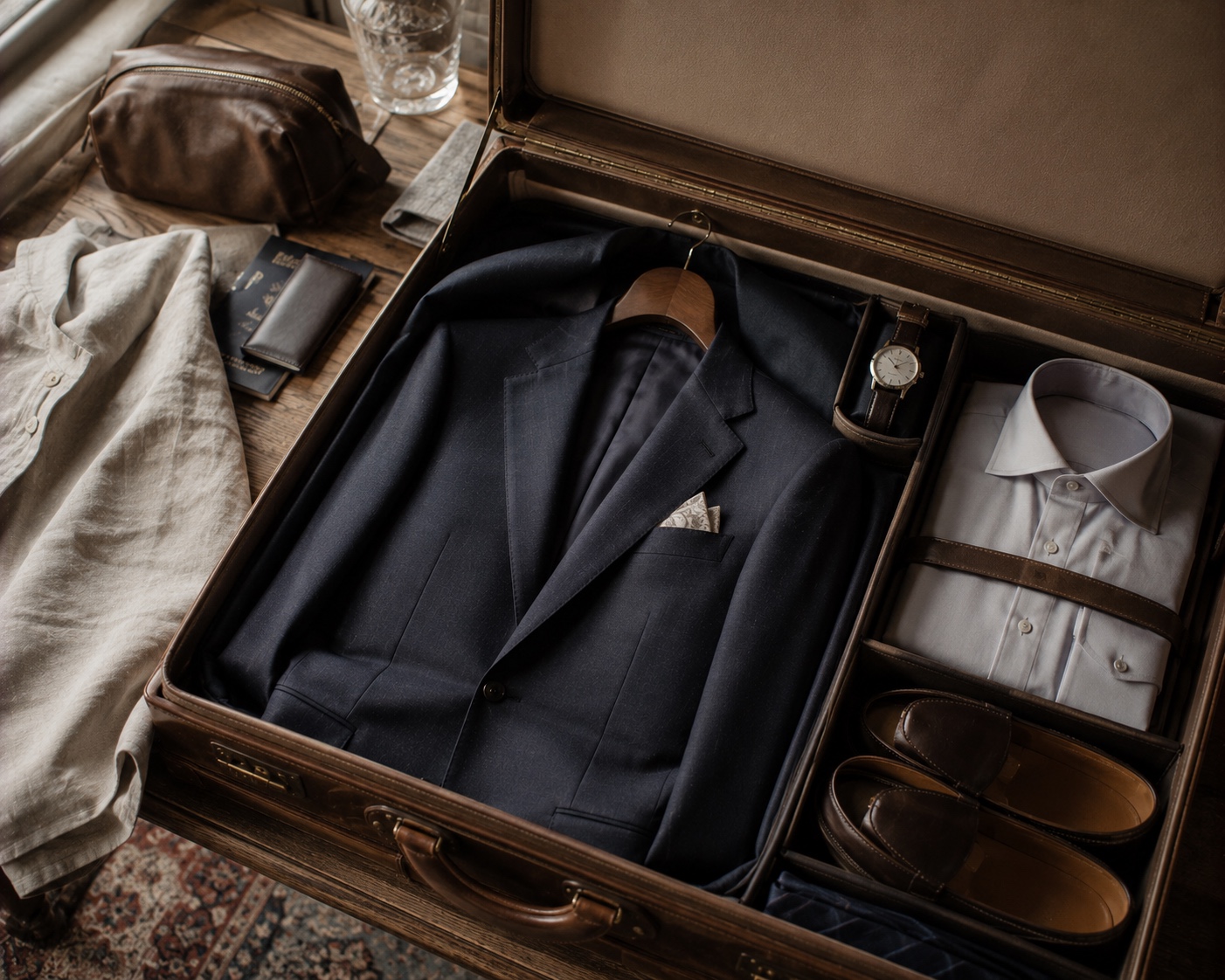
Most advice about suits assumes a single, temperate place. Real lives are rarely like that. People commute through changeable spring weather, fly to a humid city for a meeting, and spend the evening in a restaurant cooled to the temperature of a cellar. The right suit is the one that copes with where you actually are.
Five cities make the point well. None of them is an ideal; each simply pushes a suit in a different direction.
London: changeable, damp and mild
London rarely reaches extremes, but it changes its mind often. A cool morning can become a warm afternoon, and rain is never far away. This is the natural home of the year-round suit: a mid-weight worsted wool that is comfortable across most of the year, holds a press and shrugs off a shower.
Cloth weight is usually quoted in grams per metre, and in a climate like this something in the middle of the range, very roughly 260 to 320 grams, is a sensible foundation. A twill weave adds a little resilience. Layering does the rest: a knitted waistcoat or a light overcoat will carry the same suit from October to April.
New York: hot summers, hard winters
New York asks for two different answers. Its summers are hot and often humid; its winters are properly cold. A single suit that tries to handle both usually handles neither well.
The practical solution is a pair. For the colder half of the year, a heavier cloth, perhaps a flannel of 340 grams or more, gives warmth and a soft, handsome drape under a coat. For summer, a lighter, open-weave cloth and a jacket with less padding and a lighter lining will feel far better in the heat. The two can sit well in one wardrobe when their cloths, tones and textures are chosen to complement each other. A shared colour name alone is not enough, because two navies in different weights and weaves can differ noticeably in shade, texture and surface.
Dubai: extreme heat, and cold interiors
Summer in Dubai brings daytime temperatures well above forty degrees. Yet much of a working day is spent indoors, in air conditioning that can feel almost chilly. A suit here has to manage the walk from car to lobby and then sit comfortably in a cool room for hours.
Lightness is essential, but so is breathability. An open weave, such as a hopsack or an open plain weave, lets air pass through the cloth; high-twist yarn can be woven this way, though high twist alone does not make a cloth open. A jacket that is half lined or unlined, with a light canvas and soft shoulders, releases heat rather than trapping it. Lighter colours reflect sunlight, and a pale grey or soft stone can look both appropriate and cool. The cloth still needs enough body to keep its shape in a chilled boardroom.
The right suit is the one that copes with where you actually are.
Singapore: heat and humidity, all year
Singapore is hot and humid in every month, with frequent heavy rain. Humidity changes the problem. Sweat does not evaporate easily, cloth clings, and anything that creases readily will look tired by lunchtime.
Here, the construction of the yarn matters as much as the weight of the cloth. High-twist wool is springy and recovers well from creasing, and an open weave keeps air moving. Linen and linen blends breathe beautifully but crease easily, which some people enjoy and others cannot tolerate at work. Minimal lining and a soft, lightly structured jacket make a real difference, and trousers with a little room are more comfortable than a very slim cut.
Stockholm: long, dark, cold winters
Stockholm's winters are cold, dark and long, with interiors kept warm. A suit here spends much of its outdoor life under a heavy coat and much of its indoor life in heated rooms.
Warmth comes first. Flannel is ideal, as is a heavier worsted or a textured wool with some loft. Deeper colours such as charcoal, brown and bottle green suit the season and the light. Because interiors are warm, heavy cloth is best balanced with a sensible lining and layers you can remove: a fine merino knit under the jacket rather than a thick one.
What the five cities teach
- Weight sets warmth and drape. Lighter cloth for heat, heavier cloth for cold, mid-weight for changeable climates.
- Weave sets breathability. Open weaves let air through; dense, smooth weaves feel warmer and look sharper.
- Yarn sets recovery. High-twist yarns resist creasing, which matters most in humidity and on the move.
- Construction sets comfort. Less lining and lighter structure for heat, fuller structure for cold.
- Colour follows light. Paler, softer tones for sun; deeper, richer ones for dark winters and city evenings.
The shirt, the lining and the coat
A suit never works alone. In heat and humidity, a shirt in a breathable cotton, perhaps a lighter poplin or an airy weave, matters nearly as much as the cloth of the jacket, and a slightly more generous fit lets air move. In cold cities the reverse applies: a warmer shirt, a fine knit and a good overcoat take much of the load off the suit, so the suit itself need not be so heavy that it becomes uncomfortable indoors.
Linings deserve a thought as well. A fully lined jacket slides on easily and hangs cleanly, but it adds warmth. A half-lined or quarter-lined back is cooler and lighter, which is why warm-weather jackets often use one. The choice is small, but in a humid city it is one you feel all day.
If you travel between them
If one suit really must go everywhere, choose a mid-weight, high-twist wool in navy or mid-grey. It will not be perfect in Stockholm in January or in Singapore in any month, but it will be good enough in most places and will recover from a long flight.
Pack the jacket folded inside out at the shoulders, or in a garment bag if you can hang it. On arrival, hang it straight away and let a steamy bathroom lift the creases. Pack a lighter knit and a heavier one, and let layers adjust the suit to the city rather than the other way round.
A well-chosen suit does not fight the weather. It works with it, wherever the week happens to take you.